
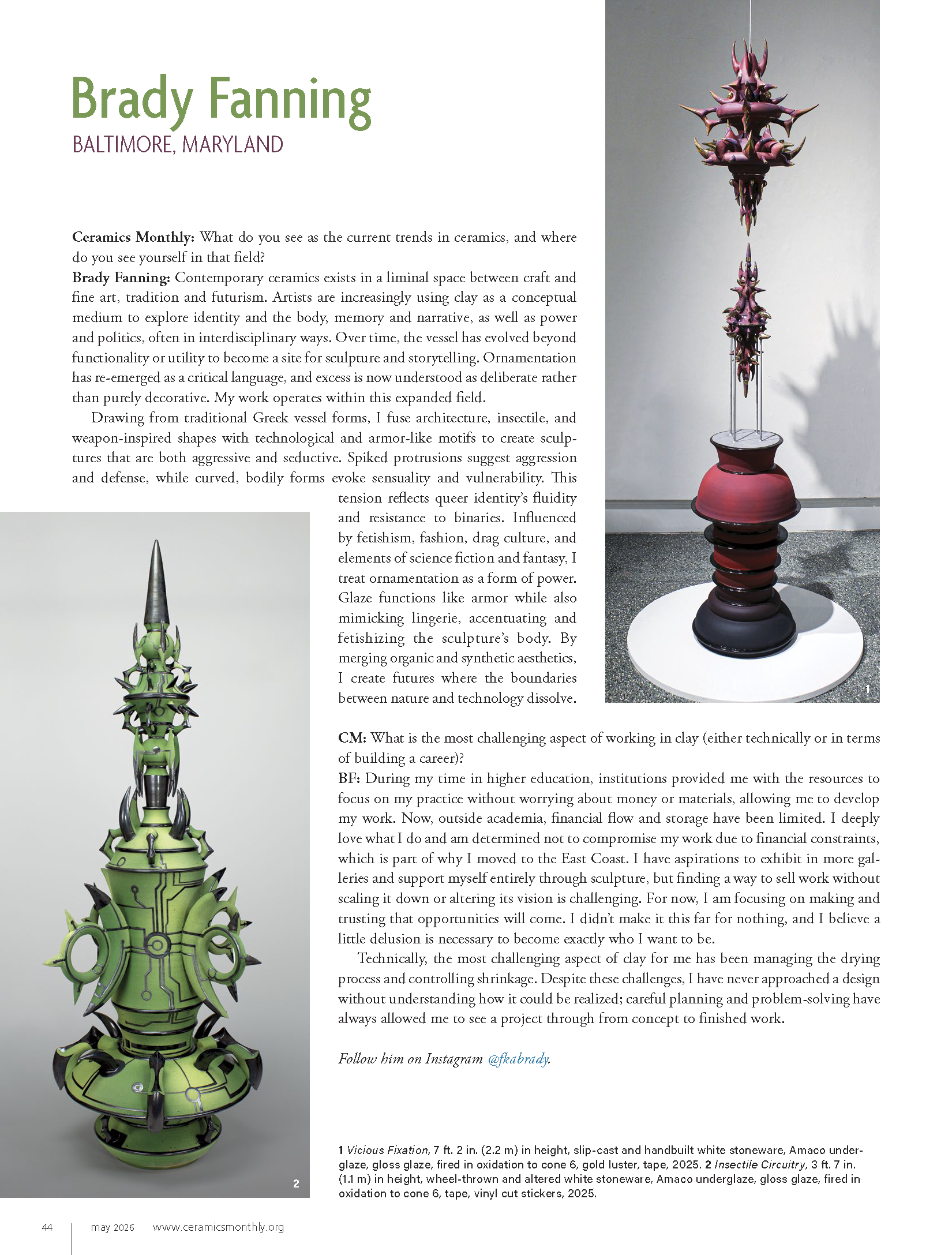
Baltimore Clayworks is proud to celebrate Brady Fanning, 2025-26 Lormina Salter Fellow, who has been named one of Ceramics Monthly’s Emerging Artists for 2026. Featured in the May 2026 issue, Brady’s dedicated Emerging Artist page highlights a bold and thoughtful studio practice that continues to gain national recognition. As a member of the Baltimore Clayworks artist community, Brady’s work reflects the creativity, innovation, and high-level artistry that define our mission. We are thrilled to see Brady honored on this national stage and excited to share this well-deserved recognition with our community.
Ceramics Monthly Interview with Brady Fanning
Ceramics Monthly: What do you see as the current trends in ceramics, and where do you see yourself in that field?
Brady Fanning: Contemporary ceramics exists in a liminal space between craft and fine art, tradition and futurism. Artists are increasingly using clay as a conceptual medium to explore identity and the body, memory and narrative, as well as power and politics, often in interdisciplinary ways. Over time, the vessel has evolved beyond functionality or utility to become a site for sculpture and storytelling. Ornamentation has re-emerged as a critical language, and excess is now understood as deliberate rather than purely decorative. My work operates within this expanded field.
Drawing from traditional Greek vessel forms, I fuse architecture, insectile, and weapon-inspired shapes with technological and armor-like motifs to create sculptures that are both aggressive and seductive. Spiked protrusions suggest aggression and defense, while curved, bodily forms evoke sensuality and vulnerability. This tension reflects queer identity’s fluidity and resistance to binaries. Influenced by fetishism, fashion, drag culture, and elements of science fiction and fantasy, I treat ornamentation as a form of power. Glaze functions like armor while also mimicking lingerie, accentuating and fetishizing the sculpture’s body. By merging organic and synthetic aesthetics, I create futures where the boundaries between nature and technology dissolve.
CM: What is the most challenging aspect of working in clay (either technically or in terms of building a career)?
BF: During my time in higher education, institutions provided me with the resources to focus on my practice without worrying about money or materials, allowing me to develop my work. Now, outside academia, financial flow and storage have been limited. I deeply love what I do and am determined not to compromise my work due to financial constraints, which is part of why I moved to the East Coast. I have aspirations to exhibit in more galleries and support myself entirely through sculpture, but finding a way to sell work without scaling it down or altering its vision is challenging. For now, I am focusing on making and trusting that opportunities will come. I didn’t make it this far for nothing, and I believe a little delusion is necessary to become exactly who I want to be.
Technically, the most challenging aspect of clay for me has been managing the drying process and controlling shrinkage. Despite these challenges, I have never approached a design without understanding how it could be realized; careful planning and problem-solving have always allowed me to see a project through from concept to finished work.
Follow him on Instagram @fkabrady.
Ceramics Monthly Publication
Originally appeared in the May 2026 issue of Ceramics Monthly and is used with permission of the American Ceramic Society.